Key takeaways
- Hosted AI APIs are the fastest, most capable place to start. Business plans from major providers typically come with contractual data protections.
- Private deployments, running models in your own cloud account or data centre, give you more control over where data lives.
- Open models have improved a lot, but the best hosted models are still usually stronger on hard reasoning tasks.
- Often the right answer is mixed: hosted for low-risk work, private for sensitive data.
- Decide using data classification, regulation, volume and the team you have, not by default.
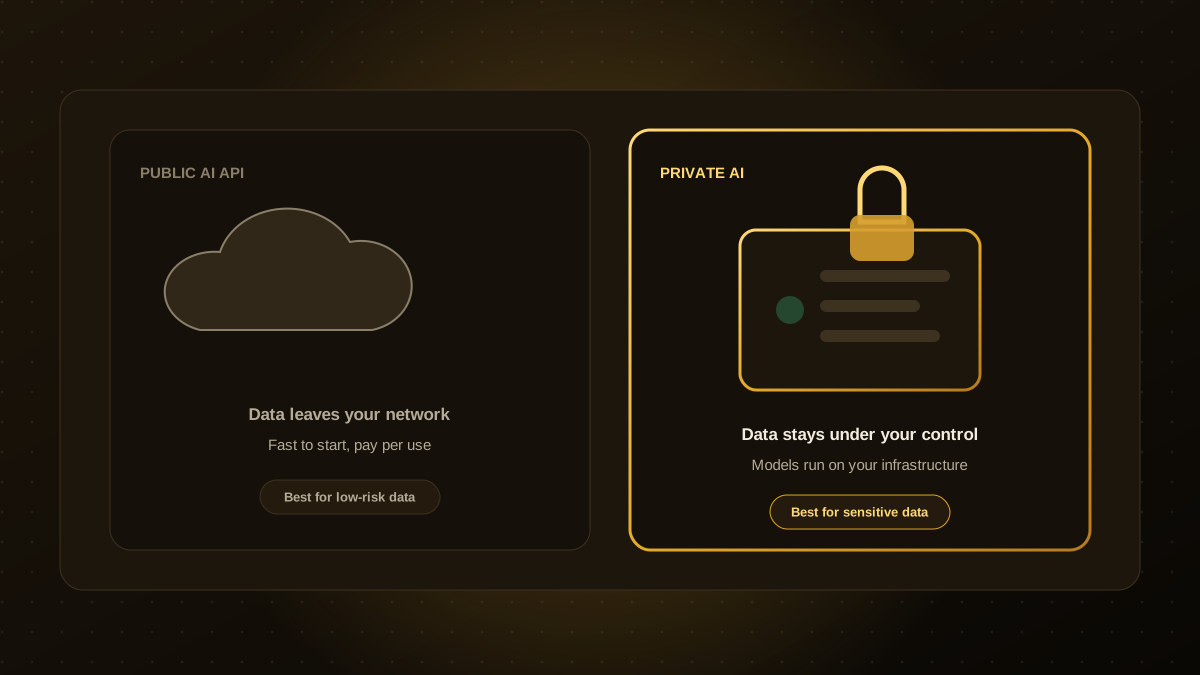
Two ways to use AI models
Cloud APIs. You send a request to a provider's service and get a response. Nothing to install, and you pay per use. Private deployment. You run a model yourself, in your own cloud account, a private cloud or your own hardware, so prompts and documents do not leave your environment.
There is also a middle path: using a major cloud provider's managed AI service inside your own account and region, with private networking and your own security controls.
Comparing the options
| Cloud API | Private deployment | |
|---|---|---|
| Time to start | Hours to days | Weeks |
| Data control | Governed by provider terms and settings | Stays inside your environment |
| Model quality | Access to the strongest models | Strong open models, often a step behind on hard tasks |
| Cost pattern | Pay per token, scales with use | Fixed infrastructure cost, efficient at high steady volume |
| Effort to run | Low | Needs ML and infrastructure skills |
| Best for | Most business use, fast progress | Highly sensitive data, strict regulation, very high volume |
What to check with a cloud provider
- Whether your data is used to train models, and how to opt out.
- How long prompts and outputs are retained, and whether zero-retention options exist.
- Where data is processed and stored, and which sub-processors are involved.
- Security certifications and the contractual terms for your plan.
- Admin controls, audit logs and single sign-on.
When private makes sense
- Regulations or contracts forbid sending certain data to a third party.
- You process very large volumes where fixed infrastructure becomes cheaper than per-token pricing.
- You need to work offline or in a restricted network.
- You want to fine-tune a smaller model for a narrow, repeated task.
Be realistic about effort: running models well means managing GPUs, scaling, updates, monitoring and security. Smaller models can be very effective for focused tasks such as classification and extraction.
A practical hybrid
Many businesses end up with a split. Low-risk tasks, such as drafting marketing copy, use a hosted API. Sensitive workflows, such as analysing contracts or patient notes, run through a private model or a managed service in the company's own cloud account. A gateway in front routes each request according to its data classification, which fits neatly with the rules in our AI governance guide.
Do not forget the retrieval layer
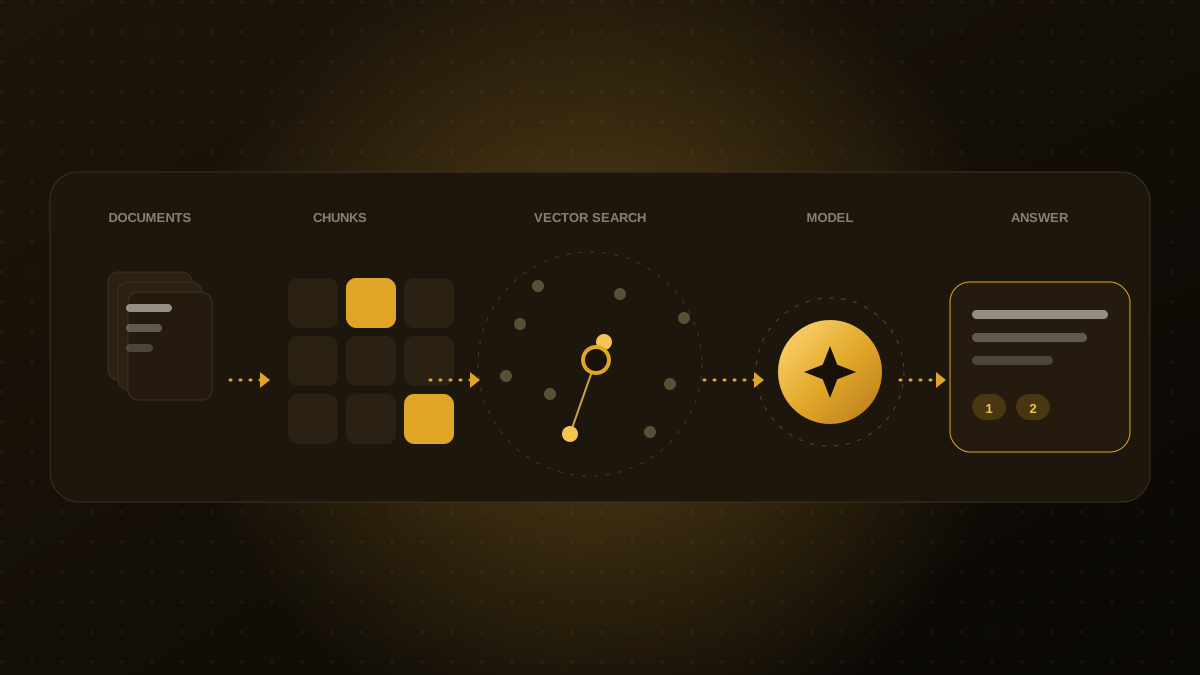
For assistants that answer from your documents, the vector store and search index also hold sensitive information and must meet the same standard, including access controls that respect who may see what. See our explainer on RAG. If you want advice on the right architecture for your data, our RAG and private AI development team can help.

Qodexify is a remote-first team of senior engineers building web apps, AI agents, workflow automation and websites. Learn more about our RAG and private AI development service or talk to an engineer.