
Service
RAG Development Services.
AI assistants that answer from your documents, with citations, access controls and measured accuracy, so your team and customers get answers they can trust.
What is RAG development?
Retrieval-augmented generation (RAG) connects a language model to your own documents. When someone asks a question, the system retrieves the most relevant passages and the model answers from them, with links to sources. This reduces made-up answers and keeps information current without retraining a model. Qodexify designs, builds and evaluates RAG systems. A typical pilot takes 3–8 weeks and costs roughly $12,000–$40,000.
What’s included
What goes into a reliable RAG system
Ingestion pipelines
Connectors for wikis, drives, tickets, PDFs and databases, with chunking that respects document structure.
Hybrid search and re-ranking
Semantic and keyword retrieval combined, then re-ranked so the right passage reaches the model.
Citations you can click
Every answer links back to its source passages so users can verify.
Permission-aware retrieval
Users only get answers from documents they are allowed to see.
Evaluation harness
A test set of real questions that measures retrieval quality and answer faithfulness after every change.
Private deployment options
Run in your cloud account or region when data must stay under your control.
Our approach
How a rag development services project runs
Choose the knowledge
We pick one source with clear ownership and a set of real questions to prove value.
Build the pipeline
Ingest, chunk, embed and index, with metadata for source, date and permissions.
Evaluate and tune
We measure retrieval and answer quality and improve until accuracy is reliable.
Roll out and expand
Launch to a pilot group, collect feedback and add sources and actions step by step.
Use cases
RAG use cases
Common projects where this service delivers the fastest return.
Internal knowledge assistant
Answer staff questions across wikis, policies, runbooks and past projects.
Customer support deflection
Resolve questions from your help centre and product documentation.
Policy and compliance Q&A
Find the right clause or procedure fast, with the source attached.
Contract and document search
Search and summarise large collections of agreements and reports.
Product and sales enablement
Give sales and success teams instant, accurate product answers.
Research assistants
Synthesise findings across reports, papers and internal analyses.
Cost & timeline
Typical timeline and budget
Indicative ranges for projects of this kind. Pricing depends on the number of sources, document quality, permissions and deployment requirements.
| Project type | Typical timeline | Typical budget |
|---|---|---|
| Single-source pilot | 3–4 weeks | $12k–$20k |
| Multi-source assistant with citations | 6–8 weeks | $20k–$40k |
| Enterprise RAG with SSO, permissions and private hosting | 8–12 weeks | $35k–$70k |
FAQ
Frequently asked questions
What is the difference between RAG and fine-tuning?
RAG changes what the model can look up; fine-tuning changes how it behaves. For company knowledge that changes, RAG is usually the better and cheaper choice because you update the index instead of retraining.
How accurate will it be?
Accuracy depends on content quality and design. We build an evaluation set from your real questions and report retrieval and answer quality, so you see the numbers rather than relying on demos.
Can it respect who is allowed to see which documents?
Yes. We store permissions as metadata and filter retrieval by the requesting user, so confidential documents are never surfaced to the wrong person.
Which data sources can you connect?
Common sources include SharePoint, Google Drive, Confluence, Notion, helpdesks, CRMs, databases and file stores. We build custom connectors where needed.
Can we host it ourselves?
Yes. We can deploy in your cloud account or region, and use private or self-hosted models when your data requires it.
How do you keep answers up to date?
Indexing runs on a schedule or on change events, and we remove stale or duplicated content so old documents do not produce old answers.
From the blog
Guides on this topic
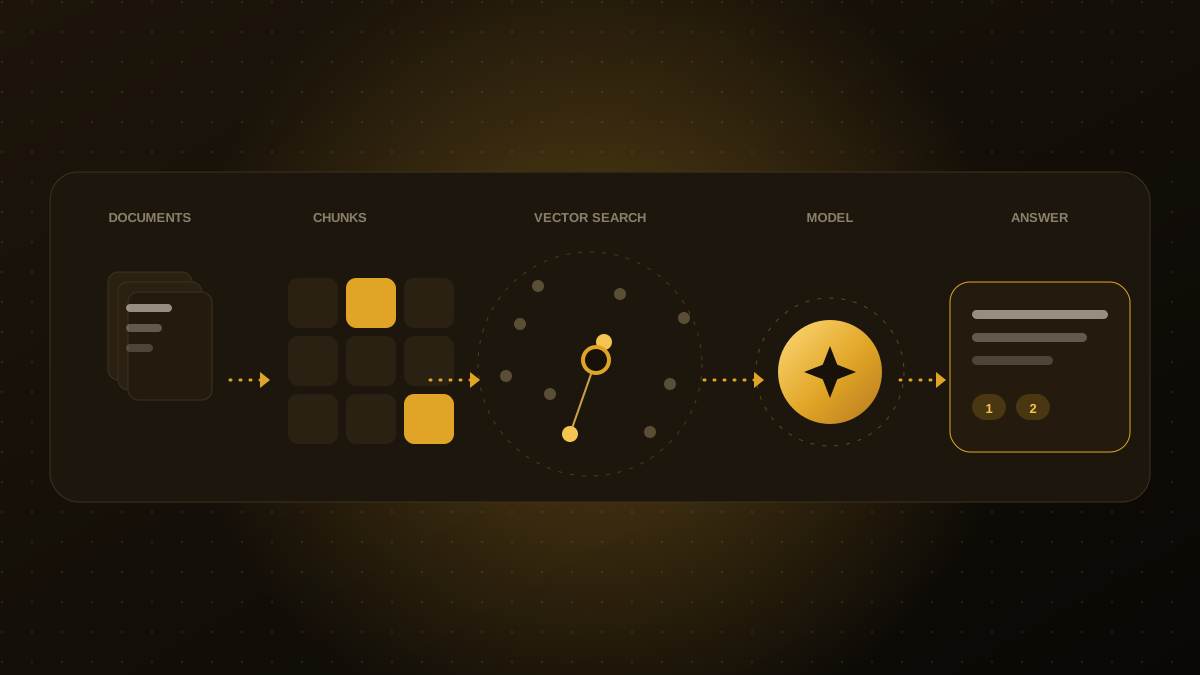
What Is RAG? Retrieval-Augmented Generation Explained for Business Leaders
RAG lets AI answer from your own documents instead of guessing. How it works, when to use it, and where projects go wrong.
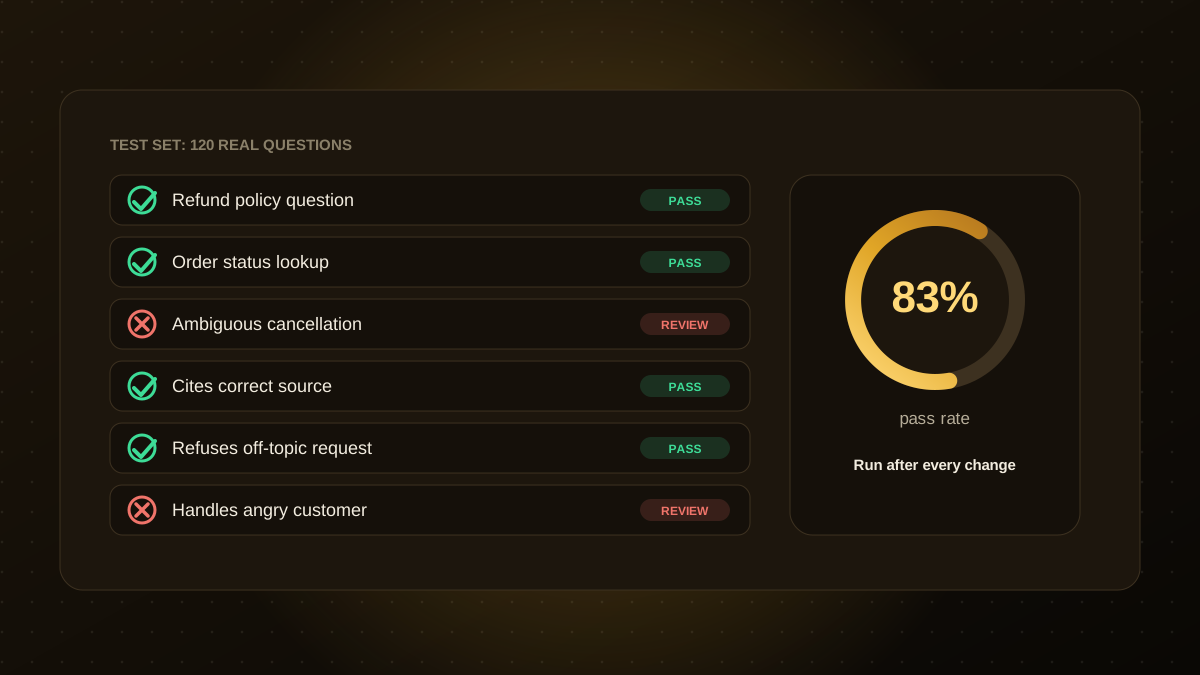
How to Evaluate an AI Agent: Build a Test Set That Catches Failures
Without tests, you cannot tell whether an AI agent is improving or breaking. Learn how to build an evaluation set, score answers and monitor quality in production.
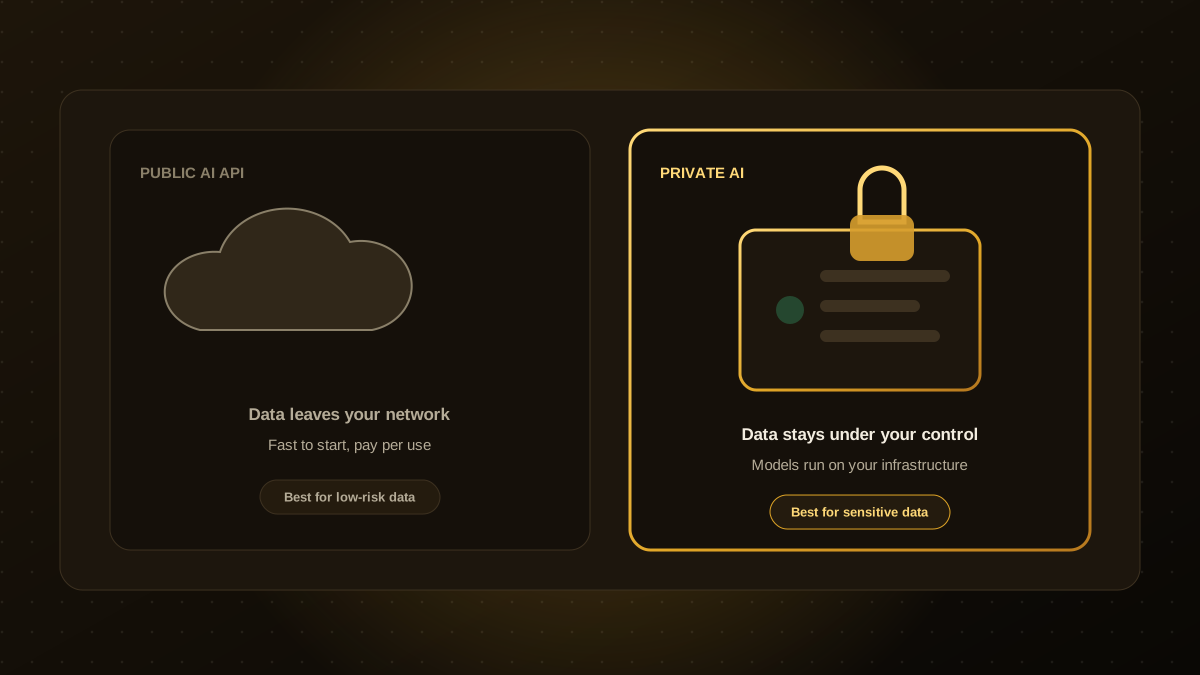
Private AI vs. Cloud LLM APIs: How to Choose for Sensitive Data
Should you send data to a hosted AI API or run models on your own infrastructure? Compare privacy, cost, quality and effort to choose the right approach for your business.