Key takeaways
- Vibe coding means building software by describing what you want to an AI tool and accepting much of the code it produces.
- It is excellent for prototypes, demos, internal experiments and validating an idea quickly.
- Prototype code often lacks tests, security, error handling, scalability and maintainability, which production software needs.
- Before real customers or real data, have an engineer review and harden the code or rebuild the foundations.
- Use the prototype as a living specification: it shows exactly what you want, which saves time and money later.
What vibe coding is
Vibe coding is a style of building software where you describe what you want in plain language and an AI tool writes the code, with you steering by trying the result and asking for changes. It has made it possible for founders, designers and product managers to create working apps in hours, not months. That is a real and valuable shift.
What it is great for
- Prototypes and demos to show investors, customers or your team.
- Validating an idea before spending real budget.
- Internal tools used by a few people with low-risk data.
- Exploring design and flow faster than static mock-ups allow.
Where the prototype breaks
The code that makes a demo work is not the code that keeps a product running. Common gaps include:
- Security. Missing access controls, exposed keys, weak input validation and unsafe handling of user data.
- Reliability. No tests, thin error handling and behaviour that only works on the happy path.
- Scale. Queries and designs that are fine for ten users and slow or costly for ten thousand.
- Maintainability. Duplicate logic, unclear structure and dependencies nobody chose deliberately, which make each change riskier.
- Operations. No monitoring, backups, deployment pipeline or plan for incidents.
- Compliance. Privacy, payment and industry rules that a prototype ignores.
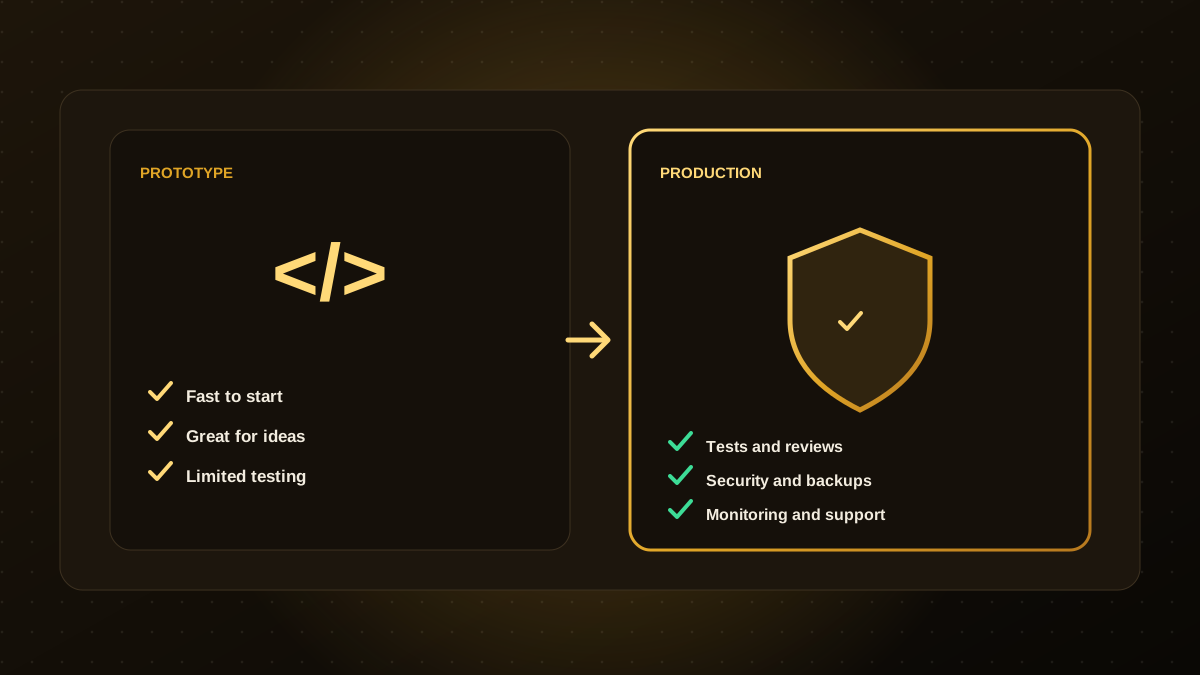
Prototype versus production
| Prototype | Production | |
|---|---|---|
| Goal | Learn and show | Serve real users reliably |
| Data | Sample or low-risk | Real, protected and backed up |
| Testing | Try it by hand | Automated tests and review |
| Security | Rarely considered | Designed in and audited |
| Failure handling | It crashes | Monitored, with recovery plans |
How to go from prototype to product
- Treat the prototype as the specification. It shows flows and screens clearly, which is hard to do in a document.
- Get a technical review. An engineer can tell you quickly whether the code is a sound base or a throw-away.
- Harden what matters first: authentication, permissions, data handling and payments.
- Add tests and monitoring around the core workflow.
- Decide whether to refactor or rebuild. Sometimes the fastest route is to keep the interface and rebuild the foundations properly.
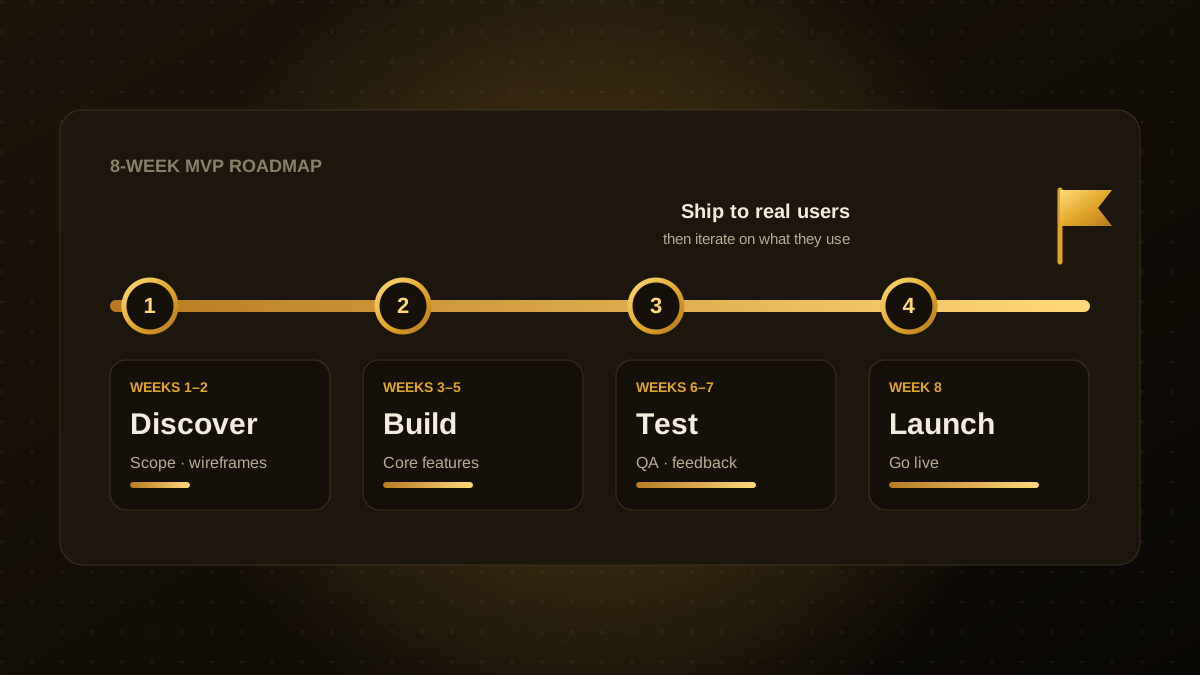
This approach pairs well with our 8-week MVP plan.
When to bring in engineers
Bring in an engineer before you handle other people's personal data, take payments, sign a customer who depends on the product, or raise money on the strength of a demo. A short review costs far less than a security incident or a rewrite under pressure. If you have a prototype and want to know what it will take to make it production-ready, our SaaS MVP development team will give you an honest assessment.

Qodexify is a remote-first team of senior engineers building web apps, AI agents, workflow automation and websites. Learn more about our SaaS MVP development service or talk to an engineer.